| Barcelona, Spain (Catalunya) |
|
|
| |
Benvigut! (welcome) Our 2006 new year started off with a visit to Barcelona, Spain over the Martin Luther King holiday weekend. This is a picture of us by the famous lizard scupture of Antoni Gaudi in Parc Guell. Gaudi is Barcelona's famous archituect and artist with his eccentric colorful and whimsical styles.
|
|
|
|
|
Unique Gaudi style buiding at the entrance of Parc Guell is his L'arquitectura gaudiniana feta jardi (Gaudi's architecture in garden form). This houses the souvenir shop.
|
Entrance of Parc Guell (1900-1904), named after Antoni Gaudi's great patron, Count Eusebi Guell. Gaudi initially wanted the park to be a gated residential community. The park was donated to the Municipal Council in 1923.
|
| |
|
|
 |
One of Gaudi's scupture made from stones. Gaudi was inspired by nature and was known to integrate his work into the natural surroundings.
|
One of Gaudi's unique architectural styles - a slanted tunnel. Dave trying to emulate the slanted arch way. I could not do it.
|
| |
|
|
 |
View of the Placa d'Espanya from Museu National d'Art de Catalunya (MNAC). This plaza was known as Porta d'entrada al recinte firal i a Montjuic (The Gateway to the trade fair precinct and Montjuic). It was the site of the 1929 Internaitional Exhibition and the 1992 Summer Olympic Games.
|
View of Barcelona's harbor from Montjuic ( Mount of the Jews). You can catch the 1929 Transbordador Aereo, a gondola ride for a scenic view.
|
| |
|
|
 |
View of Las Ramblas at dusk from high above at the top of the Columbus monument. Las Ramblas is one of Barcelona's most famous thoroughfares. It spans about one mile with lots of interesting restaurants and shops. It is basically a straight walk from Placa Catalunya to the harbor.
|
The habor reflecting off the Meditteranean Sea. The habor has a nice board walk leading to a large indoor mall.
|
| |
|
|
 |
Poble Espanyol (Spanish Village) was built in 1929 for the Barcelona's World Fair. This was such a popular venue, that the city decided to keep it as a tourist attraction. The goal was to replicate the different architectural styles throught out Spain. This is a replica of Church Las Carmelitas.
|
View of the Principe Viana in the Poble Espanyol which has different craft shops and workshops selling Spanish made goods. In the distance you can peak at the Maya's Arch. Some people find this attraction rather artificial, but worth while for those who are interested in architecture. The audio guide is necessary to understand the background of the different quarters.
|
| |
|
|
 |
La Pedrera (The Quarry) is another one of Antoni Gaudi's productions that has hit the top ten most visited attraction in Barcelona. It was built between 1906-1910. A closer look at this building reveals its wavy brick facade.
|
One of the wrought iron balconies from La Pedrera. This is unique in that it is not a straight simple balcony like the traditional balconies of the time.
|
| |
|
|
 |
The Passeig de Gracia links the Placa de Catalunya with the old village of Garcia. It is located in the uptown section of Eixample and lined with beautiful street lamp benches. This is where you can find a row of magnificent buildings that were built by wealthy landowners during the 19th century.
|
The Casa Batillo on Passeig de Gracia, is another one of Antoni Gaudi's masterpieces built between 1904-1906. This year marks it centenary and has become a legend of the Art and architecture of all time.
|
| |
|
|
|
| |
|
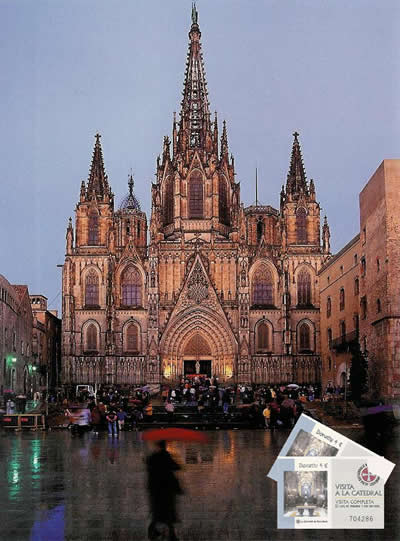
Postcard of La Catedral de Barcelona, similar to the Gothic churches of Italy, took 600 years to complete. Unique to this church is a cloister.
|
|
|
|